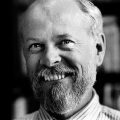
For the past nine months, retired Grace Lutheran pastor Rev. Dean Lueking has been trying to build bridges in places like Palestine, Ukraine and Ethiopia. No, he doesn’t work for Haliburton. What the reverend doctor is about is forming relationships-building bridges with Christians all over the world.
Lueking interviewed people from Bethlehem in the Holy Land to Vilnius, Lithuania to Arusha, Tanzania. He sat down face to face with Christians in Europe, Africa and the Middle East and asked them, “What is it like to be a person of the Christian faith where you are? What’s good; what’s tough; what’s surprising; what’s traditional, what is promising; what is discouraging?”
For example, while in Tanzania, he met Judith, the director of an AIDS orphanage with 36 beds, all of which are full all the time. Lueking described her as a strong, can-do woman, a combination of Mother Theresa and Annie Oakley. When he wondered about the source of her strength, Judith told him how she and the 12 people on her staff gather for prayer every morning. “They gain from each other what it takes to sustain a work like that,” he said.
Lueking began his quest for stories in November of 2005 with a journey to Palestine, which he followed up with trips to the Scandinavian countries, Lithuania, the Ukraine, Ethiopia, Kenya, Tanzania and South Africa. He will resume his travels with trips to the Far East and Australia later this year and conclude his story-collecting in South America in 2007.
“We of the Christian faith comprise 2 billion plus of the roughly 6 billion people on earth,” he said. “We ought to have something to say to each other and to the world.” If Lueking is able to follow his own timetable, he will have published a book in 2008 in which stories from Christians around the world will comprise a montage which will widen the circle of understanding in readers’ minds and spark the thought that maybe they might want to visit one of the people whose stories will be told.
Lueking uses the term “mission tourism” to describe the concept he is trying to promote. It’s networking and bridge-building, informing and broadening our vision. It’s reading the book he is working on and saying, “You know, our kids are going to travel in South Africa. If we go along, maybe we could get in touch with that man whose story Pastor Lueking told in chapter 12” or “Maybe our congregation could organize a trip to China and see firsthand what it’s like to be part of a religious minority that is growing.”
One such trip, Lueking suggested, might be to a hospital in a city called Arusha located at the foot of Mount Kilimanjaro. The director, Mark Jacobsen who has been at the hospital for 21 years and is a graduate of Harvard Medical School, told a story about a Masai tribesmen who was injured by a lion. Three lionesses attacked the Masai party. Two of the animals they fought off, but one lioness got a man’s head in her mouth, sinking her teeth into his skull and ripping off part of his shoulder with her claws.
The men carried their friend to the nearest road and rode in the back of the truck for 15 hours to Arusha. When the truck broke down near the hospital, the men carried their injured friend the rest of the way in a wheelbarrow. After three weeks of intensive care, the man’s life was saved. As he was being released from the hospital, the Masai man said to Dr. Jacobsen, “I don’t know who your God is, but I want to belong to that God. The way you’ve treated me makes me want to be baptized.”
Although only about halfway through his story collecting travels, Lueking has noticed certain common themes emerging.
-
People don’t realize how important they are where they are.
-
We don’t know enough about each other.
-
The importance of getting one’s profession of faith, knowing it and practicing it.
-
The sustaining nature of worship.
-
The good things people do for each other.
-
Against great odds people do great things.
A phenomenon that is becoming more real to him as Lueking travels, especially in Africa, is a dramatic shift which is occurring in the demographics of the Christian Church. The shift is south of the equator. For example, among Lutherans–Lueking’s denomination–there has been a 5 percent decline in North America in the last 10 years, but in Africa there has been a 73-percent increase.
“To put it in another perspective,” he said, “there are fewer Presbyterians in our country than there are Lutherans in Tanzania alone. That’s something we need to know more about.”
One of Lueking’s most memorable interviews in Africa was with Francesca, a 35-year-old single woman who worked in a primary school caring for the children, some of whom were AIDS orphans. She herself had lost a brother, a sister and their spouses to AIDS and was caring for several of her own nephews and nieces who had lost parents to the pandemic. As he interviewed her, Lueking concluded that Francesca’s strength came from being part of a community. In those difficult circumstances, the school staff and even the students surrounded her with their support.
Lueking’s wife, Beverly, has accompanied him on all but one of his journeys. “Her presence is very important,” he said, “not only to see that I get to the right airport on time, but also she is very good, particularly when I’m interviewing women. In Helsinki, for example, Beverly was sitting in a lounge knitting and attracted the attention of another woman sitting across the room. She came over and started a conversation. It turned out that the stranger had been a
missionary for 36 years in a remote part of Papua New Guinea and had fascinating stories to tell.
It was as a child that Lueking got his first taste of the potential of exchanges with people from other countries. His parents hosted a Japanese high school student for a year and a Korean college student for four years. He is still good friends with the Korean man to this day. Then spending 1951-53 as an intern in Japan really opened his eyes to the wider world. Since then he has been around the world four times.
Lueking believes travel can teach us about ourselves as well as the peoples and cultures we visit. When he came back from Palestine last November, he felt the duty to communicate to legislators that our laws and policies have to be more even-handed toward the Palestinians. He felt called to be a better citizen, to advocate to his representatives.
“Many of us already have a vision and responsibility worldwide,” he said, “but it’s not enough. We need to be much more open and interested in the life of the church in the world. Those of us in River Forest have a lot of resources, but we have an awful lot to learn.”
Lueking hopes the result of his work will be the forming of relationships around the world and the informing–the broadening of mental landscapes–of people who do not travel. “It’s person to person, congregation to congregation, pastor to pastor,” he said. “Relationship is the big word.”
When in Tanzania, Lueking asked a pastor there what American Christians could do for their brothers and sisters in Africa. The pastor replied, “It’s not what can you do for us. It’s rather what can we do together.”