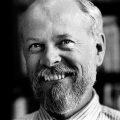


David DeMarco, M.D., S.J. has to pause sometimes and ask, “Which part of my identity am I playing out at the present moment?”
DeMarco is a physician. He practices medicine at Loyola Hospital and is an assistant professor at the Loyola University Stritch School of Medicine. He excelled at med school and trained for four years at the prestigious Cleveland Clinic. From there he moved to the Kettering Medical Center in Dayton, Ohio where he practiced medicine and taught.
While he was at Kettering, he had a life-changing experience.
“I was taking care of an elderly woman who was ‘trying to die,'” he recalled. “I remember trying to keep her alive against what I suspect was her Creator calling her home. I just wasn’t going to let that happen. My sense was that I couldn’t let her die because that would reflect badly on me.
“Finally one day I was standing by her bed and I heard something in my head. It was as though it was coming from outside of me, asking, ‘Who are you that you would do this?’ It wasn’t a malignant question. It had a kind of gentleness, but it was one of those questions that slices right through you, a defining moment, a question I was convinced had come from the divine, breaking through my shell and pointing out something about who I really am and what I really want.”
His first response to being spiritually “spun around” was to sit down with the woman’s family and tell them that she had an irreparable heart injury. He told them his advice was to withdraw everything that was prolonging her biological life and just make her comfortable, letting nature take its course.
The spiritual and emotional disorientation he was experiencing, however, would take more time. The experience of “losing his moorings” became what he called an “invitation” to walk a different path.
“I began to hear things interiorly that seemed to be invitations to follow more closely,” he said. “I began to hear that as Christ’s invitation to follow him. I responded slowly. I would take just a few steps, and a door would open. I got more interested in my patients’ lives, not just their diseases. I’d take a few more steps and began working in a homeless shelter.”
His next step was to go on retreat. That was 1991.
“On that retreat,” he recalled. “I heard much the same thing — keep following.” He felt he was being invited to go to Latin America, so he and his father, who had made several missionary trips to that region before, went to Honduras, where his father practiced dentistry and he practiced medicine.
When he returned to the U.S., another door opened. He picked up an issue of the American Medical Association which said doctors were needed on Native American reservations.
While working at the Red Lake reservation in northern Minnesota, he called the vocations director at the center where he had made his retreat a few years before and asked about becoming a Jesuit.
“There was something about the Society of Jesus,” he said, “something about its spirituality that seemed very attractive.”
What followed was a more than 10-year process of discernment, which included living with Jesuits in Chicago and Cincinnati, studying theology and spiritual direction, making retreats and listening to the spirit. He also worked at the American Indian Health Service in Chicago and lived on the Pine Ridge Indian Reservation in South Dakota.
Committing to religious community life with the Jesuits was a somewhat different decision from entering the priesthood. Becoming a priest is about the role a man will play in the overall church. Joining the Society of Jesus is a little bit like choosing the family you want to live with for the rest of your life.
Jesuit vows are unique among the religious orders that profess vows. First vows are made after the first two years. Final vows are professed about 20 years later and mark the end of formation. For DeMarco, first vows were in 1997, ordination in 2005, and final vows were in 2014. He has degrees in medicine, bioethics and theology.
Rev. Dr. DeMarco is now a physician priest — and a priest physician. And he’s not the only one. Rev. Keith Muccino, S.J., M.D., is also a professor of Medicine at Stritch School of Medicine, where he serves as an associate dean. He practices internal medicine in the Internal Medicine clinic at Loyola.
The house where DeMarco, Muccino and three other Jesuits live on South Clinton Avenue in Oak Park is owned by the Jesuit order. All five work at either Loyola University or the Loyola University Health System. They live “in community,” doing their own cooking and celebrating Mass every day after work.
According to DeMarco, Ignatian spirituality makes it easy to combine practicing medicine, living the religious life in community, and serving as a priest — at least in theory. In practice it’s a lot more difficult.
Last fall, for instance, he spent a few weeks at the Red Lake reservation. “I was in the outpatient clinic,” he said, “when I received a call that I was needed in the emergency room. A teenage girl had been killed by gunshot and the family wanted me to pray with them. I stepped into the circle of a family of 20 or 30 people, but I’m dressed to practice medicine with a white coat and a stethoscope dangling around my neck, and I’m leading prayers for the recently deceased and for the family that is grieving. I remember wishing at that moment that I had something different on, an alb and a stole. I thought it would be easier to pray if I were wearing something different.”
His work at Loyola these days includes saying Mass on the weekends, helping with spiritual direction, practicing medicine, and teaching medical students. It’s easier for him to transition from role to role, he said, if he has “a little space to shift gears.”
With so many roles to juggle, he finds he has less and less time to himself. He feels most himself “when I’m in the mountains of Colorado, where I feel most connected to the mystery of God, or in South Dakota, in the midst of that wide open prairie.”
But healing takes place in multiple ways.
“I also feel really myself when I’m doing spiritual direction,” he noted, “when I’m engaged in spiritual conversation. There’s something about sitting with people and listening to the story of how the spirit is moving in their lives that resonates. It’s a privileged place of listening to things which seldom are spoken, seldom shared with another human being.”